Health and Safety Policy for Gardeners Feltham
 This health and safety policy sets out the standards expected from gardeners in Feltham when carrying out professional outdoor work. It is designed to protect staff, clients, visitors, and the public by reducing the risks linked to gardening tasks, machinery use, manual handling, weather exposure, and site-specific hazards. Every member of the gardening team is expected to work with care, follow safe methods, and take responsibility for their own actions and the wellbeing of others around them.
Gardening can involve a wide range of activities, from mowing lawns and pruning hedges to lifting waste, using sharp tools, and working near uneven ground. Because these tasks vary from site to site, a consistent safety approach is essential. Garden maintenance services must be planned with awareness of the environment, the condition of the equipment, and the physical demands of each job. Safe working practices help prevent injuries, property damage, and avoidable disruption.
 All gardeners are required to assess hazards before starting any task. This includes checking for slip risks, broken paving, concealed obstacles, unstable ladders, electrical equipment, wildlife, and nearby people or pets. When conditions change during the day, the work should be paused and reviewed. A sensible, proactive approach is a core part of our garden safety policy.
Training is a key part of maintaining high standards. Team members should only use equipment they have been trained to operate and should understand the correct techniques for lifting, cutting, transporting materials, and storing tools. Professional gardeners must also be familiar with the safe use of fuel-powered and electrically powered tools, including how to check for damage before use and how to stop work if equipment becomes unsafe. Supervisors should ensure that workers remain competent and updated as tasks or equipment change.
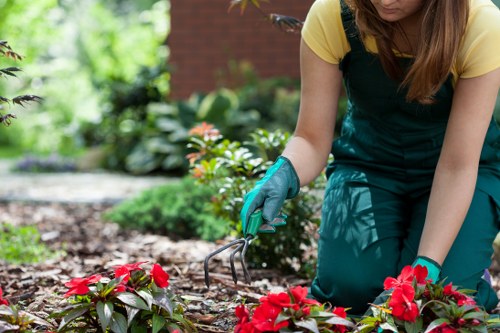
Personal protective equipment, or PPE, must be selected according to the task. This may include gloves, safety boots, eye protection, hearing protection, high-visibility clothing, and weather-appropriate clothing. PPE does not replace safe systems of work, but it adds an important layer of protection. In a garden maintenance policy, it is essential that PPE is worn correctly, kept in good condition, and replaced when it no longer provides proper protection.
Manual handling is another important concern within gardening health and safety. Soil bags, pots, branches, and garden waste can be heavy or awkward to move. To reduce the risk of strain, loads should be assessed before lifting, moved in smaller quantities where possible, and carried using safe posture and good planning. Mechanical aids should be used when available, and team members should ask for support when a load is too bulky or too heavy for one person to handle safely.
 Weather conditions must be monitored throughout outdoor work. Excessive heat, cold, rain, frost, high winds, and poor visibility can all create risks for gardeners. Breaks, hydration, suitable clothing, and adjusted work schedules may be necessary to keep work safe. If severe weather makes a task unsafe, it should be postponed. Outdoor safety procedures should always reflect the realities of the site and the conditions on the day.
Equipment inspection and maintenance are essential for reducing accidents. Tools should be checked before use, cleaned after use, and stored securely when not in service. Blades must be sharp but safe, guards must be in place, and cords or batteries should be handled with care. Any faulty item should be removed from use immediately and reported for repair or replacement. Good maintenance supports both safety and efficiency in garden care services.
Housekeeping also contributes to a safe working environment. Waste, cuttings, cords, and tools should not be left in walkways or work areas. Spillages should be cleaned quickly, access routes kept clear, and materials arranged neatly to avoid trips and falls. A tidy site helps everyone work with greater confidence and lowers the chance of injury during routine tasks or larger landscaping activities.
In addition to physical hazards, communication is central to a strong safety culture. Team members should share information about site conditions, hazards, lone working arrangements, and task changes before and during work. Where more than one person is present, clear instructions and agreed signals reduce confusion and prevent accidental contact with tools or machinery. A well-organised gardeners’ safety policy supports teamwork and accountability.
Emergency preparedness is also included in this policy. Workers should know how to respond to cuts, falls, eye injuries, equipment accidents, and other common incidents. First aid supplies should be accessible, and serious accidents must be escalated without delay. Staff should stop work if an incident creates further risk and ensure the area is made safe before resuming. Recording accidents and near misses helps identify patterns and improve future practice.
 Safe working in gardens relies on regular review. This policy should be updated when risks change, when new equipment is introduced, or when experience shows that procedures can be improved. Managers and workers alike should treat safety as part of everyday service quality rather than as a separate concern. By maintaining clear standards, the team can deliver reliable results while protecting people, property, and the surrounding environment.
Gardeners should also respect boundaries, permissions, and the condition of the site before beginning work. Gates, ponds, slopes, delicate planting, and hidden services may all require extra caution. Where a task involves cutting back vegetation or clearing overgrowth, checks should be made to avoid disturbing unknown hazards. Careful planning is especially important when work takes place in confined areas or where access is limited.
 In summary, this health and safety policy for gardeners promotes safe habits, responsible equipment use, good communication, and awareness of changing conditions. By following these standards, gardeners can reduce risk and carry out their work effectively, professionally, and with due care at all times.